
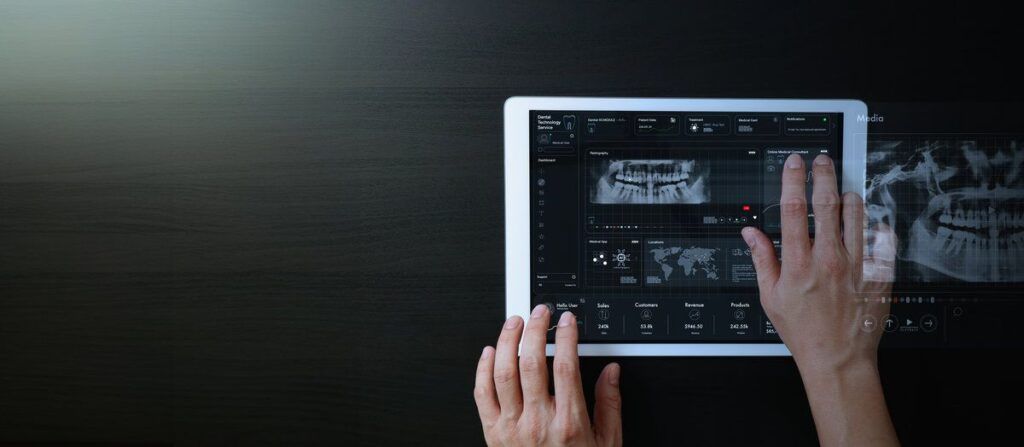
The way dentists identify cavities is evolving faster than most patients realize. For decades, detecting tooth decay meant relying on visual exams, manual probing, and X-ray images interpreted by a trained human eye. Today, artificial intelligence is stepping in to help dental professionals catch what might otherwise be missed, flagging early signs of decay before a small problem becomes a costly one.
At Johns Creek Dental Associates, we believe in staying at the forefront of dental technology because our patients deserve the most accurate, thorough care available. That commitment is why we use advanced digital X-rays and AI-powered diagnostic tools to give every patient the clearest picture of their oral health. When technology and clinical expertise work together, the results speak for themselves.
How Does AI-Powered Cavity Detection Work?
AI cavity detection works by analyzing dental radiographs using machine learning algorithms trained on thousands of clinical images. These systems can identify patterns associated with early-stage decay, cracks, and bone loss that may not be immediately obvious to the naked eye during a routine review.
The technology does not replace the dentist. Instead, it functions as a second set of eyes, drawing attention to areas of concern so the clinician can evaluate them more closely. Think of it as a precision tool that enhances the accuracy of the diagnostic process rather than automating it. The dentist still makes every treatment decision.
The Science Behind the Technology
Research published in the National Institutes of Health’s PubMed database supports the effectiveness of AI in this space. An umbrella review and meta-analysis examining AI diagnostic accuracy for dental caries found a pooled sensitivity of 0.85 and a specificity of 0.90 across a broad range of imaging modalities, representing a meaningful improvement in catching decay that might otherwise be missed on first review. These numbers reflect how consistently AI can identify cavities that are actually present while minimizing false positives.
The implications for patient care are significant. When cavities are caught earlier, treatment is simpler, less invasive, and easier on the patient’s budget. Waiting until decay becomes visible or symptomatic often means the difference between a small filling and a root canal or crown.
Pearl AI: What We Use at Our Practice
One of the AI systems making waves in preventive dentistry is Pearl, a platform specifically built for dental radiograph analysis. Pearl uses computer vision to analyze X-ray images in real time, surfacing findings with a level of consistency that supports more thorough diagnostic evaluations.
At Johns Creek Dental Associates, we use Pearl as part of our AI dentistry approach to comprehensive care. After exploring the technology at a dental conference and completing a trial period, our team fully adopted Pearl because of how much confidence it adds to our diagnostic process. When we take X-rays, Pearl reviews the images alongside our clinical team, helping us ensure nothing is overlooked.
What This Means for You as a Patient
For patients, AI-assisted detection translates into a more thorough and transparent dental visit. Many AI systems can display their findings on a screen, allowing patients to see what the dentist sees. This changes the conversation from a one-sided recommendation to a visual, shared discussion about the health of your teeth.
AI detection is particularly valuable for identifying interproximal cavities, which develop between teeth and are difficult to detect with visual inspection alone. These are among the most commonly missed in traditional exams and are also some of the most important to catch early. With AI in the mix, patients benefit from a more comprehensive screening at every visit.
The Future of Dental Diagnostics
The role of AI in dentistry will only continue to expand. Beyond cavity detection, machine learning tools are already being applied to periodontal disease assessment, bone level analysis, and even predicting which teeth may be at higher risk for future decay based on structural patterns. The field is moving toward a model where data and clinical judgment work hand in hand.
For patients who want a dental home that invests in the latest tools available, the type of technology a practice uses matters. AI is not a gimmick; it is a genuine advancement that helps dentists provide better care, backed by science and refined through clinical use.
Experience Advanced Dental Care at Johns Creek Dental Associates
Our team is proud to bring innovative, evidence-based tools to every appointment. Dr. Choi and Dr. Chen stay current with the latest advancements in dental technology, including AI-assisted diagnostics, so that every patient at our practice benefits from care that reflects the profession’s current standard. Combining compassionate attention with cutting-edge tools is what sets our approach apart.
If you are ready to experience comprehensive dental care that uses the latest in diagnostic technology, we would love to meet you. Contact us today to schedule your next appointment and discover what modern dentistry looks like at Johns Creek Dental Associates.