
Medically Reviewed by Dr. Jeffrey Chen, DMD on July 28, 2026
The VELscope oral cancer screening is a quick, painless exam that uses a special light to reveal tissue changes in your mouth long before they would be visible during a standard checkup, and it plays an important role in catching oral cancer at its most treatable stage. Most people leave a dental appointment focused on their teeth, but one of the most important things we check has nothing to do with cavities or plaque. Oral cancer is among the most serious conditions a dental provider can detect, and it is most treatable when caught before visible symptoms ever appear.
At Johns Creek Dental Associates, preventive dentistry is at the core of our approach to patient care. Our team believes that identifying problems early, before they escalate, leads to simpler treatment and better outcomes. Incorporating the VELscope into routine oral cancer screenings is a direct extension of that philosophy, providing patients with an added layer of protection at every appointment.
How the VELscope Works
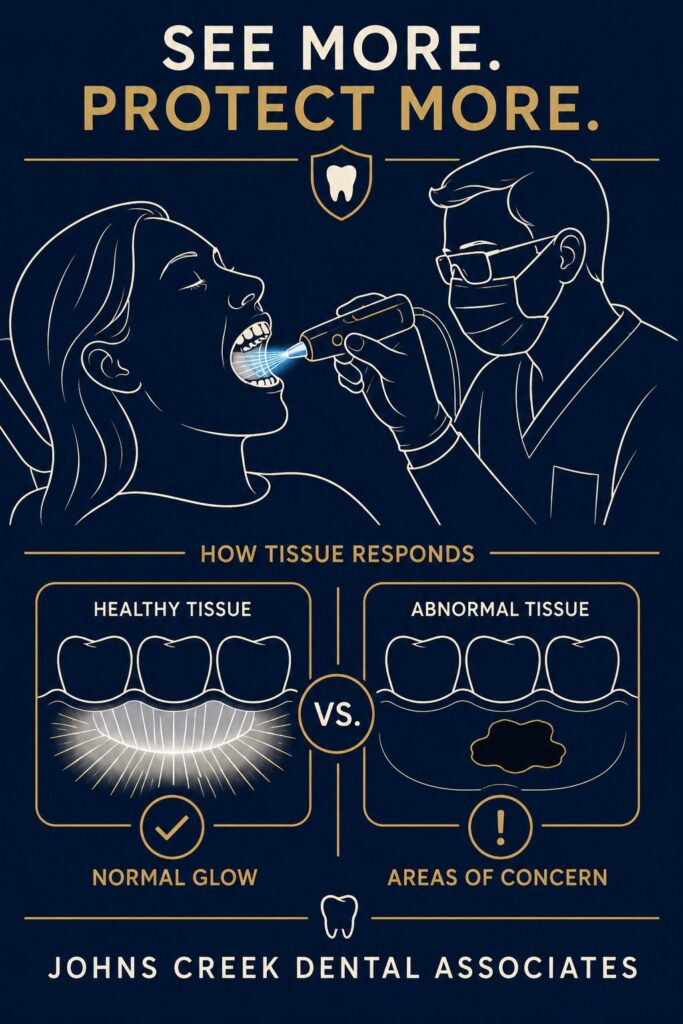
The VELscope is a handheld device that emits a specific wavelength of blue light to illuminate the soft tissues inside your mouth. Healthy tissue responds by naturally fluorescing, appearing bright green when exposed to light. Tissue with abnormal cellular activity absorbs the light differently and appears dark, making it stand out to the clinician during the exam.
What to Expect During the Screening
The exam takes only a few minutes and is completely painless. After gently dimming the lights in the operatory, your provider uses the device to scan the soft tissues of your mouth, including areas beneath the tongue, along the gum line, and toward the back of the throat. No dye or rinse is required, and there is no recovery time afterward. Research published through the National Institutes of Health has demonstrated the effectiveness of fluorescence-based imaging in identifying oral lesions that appear normal under conventional examination lighting, supporting its role as a valuable adjunctive screening tool in dental practice. We also perform a standard visual and physical exam of your lips, cheeks, tongue, and neck alongside the VELscope, since the two approaches work best together rather than as substitutes for one another.
Why Standard Exams Have Limitations
A conventional visual exam under white light can detect many oral health concerns, but it cannot detect changes occurring at the cellular level. Early-stage oral abnormalities can look completely normal to the naked eye, which is why so many oral cancers are not identified until they have already progressed. The VELscope adds a second tier of evaluation that helps close that gap.
Why Early Detection Matters
Oral cancer is more common than many people realize. According to the National Institute of Dental and Craniofacial Research, more than 450,000 people in the United States are currently living with a diagnosis of oral cancer. The disease can affect the lips, tongue, cheeks, floor of the mouth, and throat, and early-stage lesions often look identical to minor irritations or canker sores.
The stage at which oral cancer is found makes a substantial difference in the treatment path and long-term outlook. Cancers caught while still localized to the mouth are generally far more manageable than those discovered after they have spread to nearby tissue or lymph nodes. This is exactly why routine screening matters even when nothing feels wrong, since the earliest changes rarely cause pain or obvious symptoms.
Screenings like this are most effective when paired with consistent preventive care. We typically perform the VELscope exam during your regular teeth cleaning visits, and when a closer look at underlying structures is needed, our digital X-rays provide additional detail that soft-tissue screening alone cannot capture.
Who Should Get This Screening?
This screening is appropriate for most adult patients, not just those with obvious risk factors. While tobacco and alcohol use remain the most widely recognized contributors, a growing number of oral cancer cases are linked to HPV, and the disease can develop in people who have never smoked. Some of the key groups who benefit most from VELscope screenings include:
- Tobacco users: Cigarette, cigar, and smokeless tobacco use all significantly elevate oral cancer risk
- Alcohol users: Heavy alcohol consumption compounds the risk, particularly when combined with tobacco
- HPV-positive individuals: HPV-related oral cancers are increasingly prevalent among younger adults
- Previous oral cancer patients: Anyone with a prior diagnosis should be monitored regularly
- Patients with unexplained oral changes: Persistent sores, white or red patches, or numbness warrant close attention
Discussing your personal risk profile with your provider is the best way to determine how frequently the VELscope screening makes sense for you.
Benefits and Limitations of VELscope Screening
VELscope adds real value to a routine exam, but it works best as one part of a broader screening approach rather than a stand-alone diagnostic test. The device highlights areas of tissue that fluoresce differently than the surrounding area, which helps your provider notice patterns that could otherwise be missed. It is quick, non-invasive, and adds only a few minutes to a routine visit.
At the same time, an area of altered fluorescence does not automatically mean cancer is present. Inflammation, minor injuries, and other benign conditions can also change how tissue responds to the light, so any area of concern is evaluated in context with your health history and, when needed, followed up with additional testing such as a biopsy. Used this way, alongside a thorough visual and physical exam, VELscope gives your care team another useful data point rather than a final answer on its own.
What Happens If Something Is Found?
A positive finding during a VELscope exam does not automatically indicate cancer. Many areas of irregular fluorescence are benign tissue changes, mild inflammation, or areas of irritation. What the device does is flag tissue that may need closer attention.
Next Steps After a Finding
If an area of concern is identified, your provider may monitor it over a follow-up period, order additional imaging, or refer you to oral surgery for further evaluation. The process is methodical and measured, focused on gathering information rather than drawing premature conclusions. Should additional care be necessary, our restorative dentistry services are available to support your full recovery. Every step is handled with clarity, and patients always understand what is happening and why.
Frequently Asked Questions About VELscope Oral Cancer Screening
How often should I get a VELscope screening?
Most patients benefit from a VELscope screening at each routine dental visit, typically every six months, since this device adds only a few minutes to your appointment. Patients with elevated risk factors, such as tobacco or heavy alcohol use, a history of HPV, or a previous oral cancer diagnosis, may benefit from more frequent monitoring. Your provider can recommend a schedule based on your personal health history.
Does VELscope replace the need for a biopsy?
No, VELscope is a screening tool, not a diagnostic one. If an area of concern is identified, a biopsy and laboratory analysis are the only way to confirm whether abnormal tissue is cancerous, precancerous, or a benign change. VELscope simply helps your provider decide which areas deserve this closer look.
Is the VELscope screening covered by dental insurance?
Coverage varies by plan, since some insurers classify this as an adjunctive screening rather than a standard part of a routine exam. Our team can help verify your specific benefits before your appointment so there are no surprises. Many patients find the value of early detection outweighs any modest out of pocket cost involved.
Can VELscope detect problems that a visual exam would miss?
Yes, that is the main advantage of this technology. Early-stage tissue changes often look completely normal under standard lighting, but they can respond differently under the VELscope’s blue light. Using both methods together gives your provider a more complete picture than either approach alone.
Am I at risk for oral cancer even if I do not smoke or drink?
Yes, a growing share of oral cancer cases occur in people without traditional risk factors, largely due to HPV-related cases rising among younger, otherwise healthy adults. Anyone with persistent sores, unexplained white or red patches, or lasting numbness in the mouth should have those changes evaluated regardless of their tobacco or alcohol history.
Schedule Your Screening at Johns Creek Dental Associates
At Johns Creek Dental Associates, we offer comprehensive dental services designed to look after your oral health at every stage. Our team brings advanced training and a patient-centered approach to every appointment, and the VELscope is one way we go beyond a routine check to provide patients with thorough, thoughtful care. Our team serves the diverse communities of Johns Creek, Alpharetta, Duluth, and Suwanee with the kind of personalized attention every patient deserves.
If you are ready to schedule your next visit and would like to include a VELscope oral cancer screening, please use our contact form to get started.

About the Author
DMD | General and Family Dentistry
Dr. Jeffrey Chen provides comprehensive family dentistry at Johns Creek Dental Associates with a patient-centered approach to every visit. He earned his dental degree from the Dental College of Georgia at Augusta University after completing his undergraduate studies at Emory University. Dr. Chen is known for making even complex procedures feel comfortable and straightforward for patients.